By Giacomo Esposito · The STR Engine
If you manage a destination property, the kind of place people book six or nine months out because of a ski season, a festival, or a once-a-year event, Airbnb just quietly rewrote your risk model.
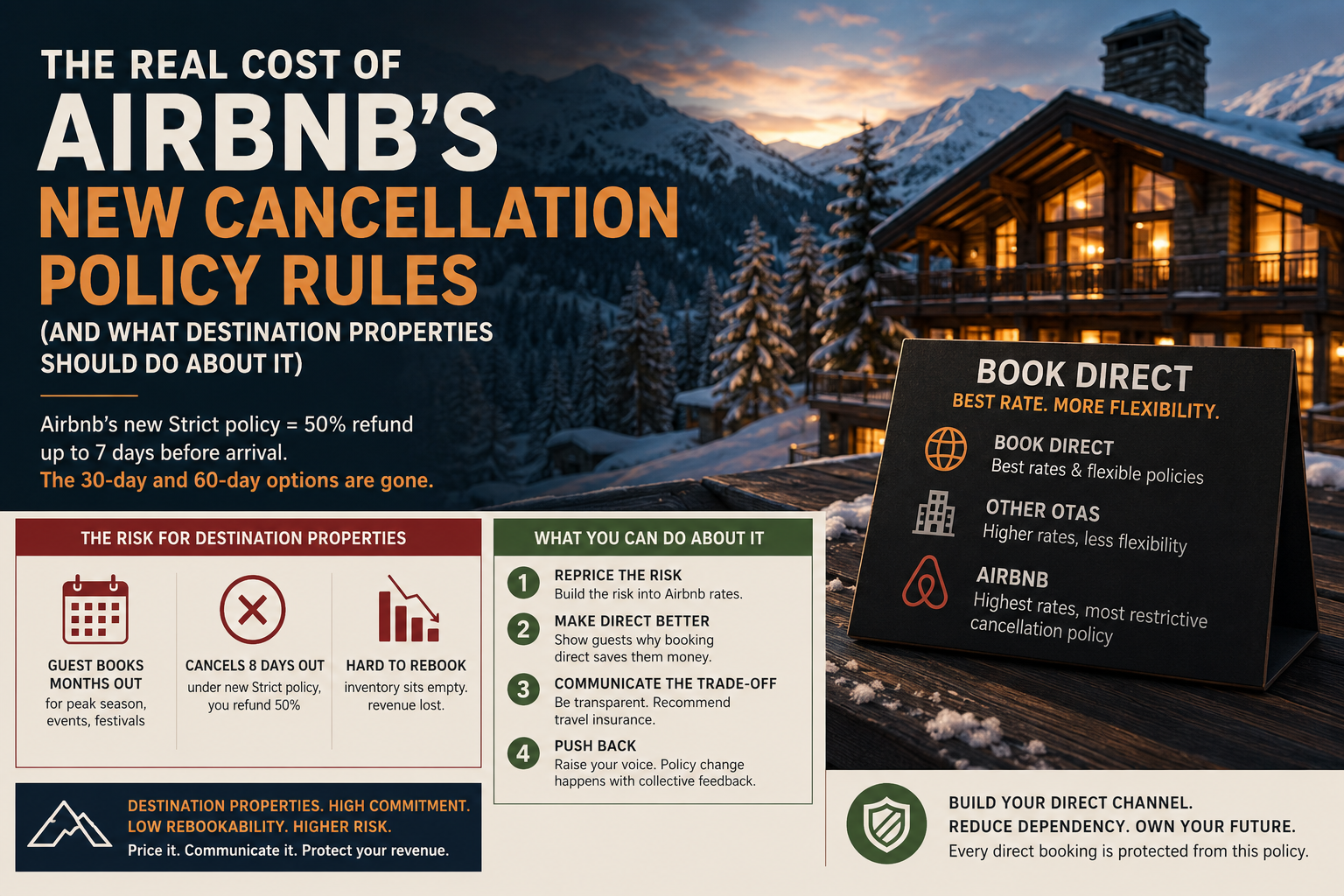
As of mid-September, the strictest cancellation policy Airbnb allows hosts to set is Strict: a 50% refund if the guest cancels up to seven days before arrival. The longer-window policies many destination operators relied on, the 30-day and 60-day tiers, are gone. If your property type has ever depended on early, high-value bookings that guests understand to be effectively non-refundable, this change lands directly on your P&L.
This isn't a minor policy tweak. For operators running destination markets, ski towns, coastal resort areas, festival and event locations, this is a structural shift in how much risk you're carrying on every Airbnb reservation.
Why This Hits Destination Properties Harder Than Anyone Else
Airbnb's cancellation framework was built with broad applicability in mind: city breaks, weekend trips, the kind of stay where a guest books three weeks out and a seven-day cancellation window feels reasonable to both sides.
Destination properties don't work that way. A guest booking a mountain lodge for Christmas and New Year's, or a villa for a festival week, is typically booking months in advance, often before flights are even confirmed, and the operator is pricing, staffing and planning around that commitment. In these markets, unlike a city apartment, a cancellation two or three weeks out during peak season often doesn't rebook at all. There's no walk-in demand to absorb it. The inventory simply sits empty.
Under the old 60-day strict policy, guests who cancelled well outside that window forfeited the booking value, guests understood the trade-off, and operators could price and staff with real confidence. Under the new Strict tier, that confidence disappears. A guest can hold your Christmas week for months, cancel eight days out, and you're left with half the revenue and almost no runway to fill the gap.
What You Can Actually Do About It
The instinct here is to feel stuck, especially if you're running your properties through a PMS like Guesty, where the platform-level cancellation policy options are simply constrained to whatever Airbnb allows. You don't get to invent a stricter tier. But "stuck on Airbnb's policy" doesn't mean stuck overall. It means the strategy has to shift from policy to structure.
1. Reprice the risk directly into your Airbnb channel
If Airbnb is now the highest-risk channel for a destination property, price it that way. Many operators run a flat markup on OTA channels versus their direct site, often in the 10-15% range. For destination markets exposed to this new policy, it's worth revisiting that number upward specifically for Airbnb, not as a punitive move, but as a rational reflection of the actual cancellation exposure that channel now carries. If a cancelled peak-week booking effectively costs you the full nights, that risk has a price, and it belongs in the rate, not absorbed silently by the business.
2. Make your direct channel visibly the better deal
This is the moment to lean hard into direct bookings, and to say so plainly to guests. A simple, transparent pricing hierarchy, shown to guests both digitally (a QR code in the listing or check-in materials) and physically (a printed card in the unit) works well: your own website first, other OTAs next, Airbnb clearly positioned as the most expensive way to book. Guests are capable of understanding "book direct, pay less, more flexibility", and destination guests in particular, who are often repeat visitors, respond well to being let into that logic once.
3. Communicate the trade-off, don't just absorb it
Guests booking a destination property for a fixed, high-demand date already intuitively understand that flexibility has a cost. Say it clearly in the listing description and in your pre-booking messaging: peak dates in a destination market carry real risk for the operator, and the cancellation terms reflect that. Guests who feel informed rather than caught out are far less likely to dispute or leave a bad review when a policy is enforced. This is also where travel insurance becomes worth actively recommending at time of booking, not as an afterthought, but as the tool that actually solves the guest's flexibility problem without costing you anything.
4. Push back through the channels available to you
Individually, one operator complaining to Airbnb changes nothing. But policy changes like this one are shaped by aggregate host feedback, and destination-market operators have a legitimate, specific case to make: broad city-stay policies don't fit high-commitment, low-rebookability markets, and a middle tier that reflects that difference would serve guests and hosts better. If you have any existing relationships with Airbnb account management or policy contacts, this is worth raising directly and specifically, not as a generic complaint, but as a clearly reasoned case for why destination markets need different rules.
The Bigger Picture
This change is a useful forcing function, even if it doesn't feel like one right now. Operators who have spent the last few years building a real direct booking channel, a loyalty base, a clean owner-guest communication flow, are far better positioned to absorb this than operators who have treated Airbnb as their only real distribution channel.
If your business is still heavily Airbnb-dependent for a destination property, the medium-term answer isn't just repricing, it's reducing that dependency. Every guest who books direct next season is a guest this policy simply doesn't touch.
If you're managing a destination property and want to work through what this means for your specific pricing, channel mix, or cancellation strategy, get in touch. I work with STR operators and PMCs on exactly this kind of channel and revenue strategy, and I'm happy to help you build a plan that protects your peak-season revenue rather than leaving it exposed.
Frequently Asked Questions
Giacomo (Jack) Esposito is the founder of The STR Engine, a consulting firm that helps short-term rental operators and property management companies build direct booking channels, optimise pricing, and reduce OTA dependency.